Find the zombie tasks before you buy the tool
Every workplace has tasks that refuse to die. They come back on Monday morning, at month end and every time a new client signs on. Nobody decided they should take this much time, and nobody remembers why they are done this way. We call them zombie tasks.
When a company decides to use AI, it is tempting to start with the tool. Someone has seen a demo, bought a licence or tried a new AI assistant, and the question becomes: “What can we use this for?” That is the wrong order. The tool should solve a problem you have already defined, not go looking for one to justify the purchase.
What is a zombie task?
A zombie task is repetitive work that takes little judgement and a lot of time. It survives on habit, not because anyone has checked whether it still creates value. Typical signs:
- It is done the same way every time, often by unwritten rules.
- It is mostly copying, reordering or checking information between systems.
- It comes up weekly or more often.
- People put it off, but nobody can skip it.
- When the person who does it goes on holiday, something stops.
Most people know the examples: a weekly report stitched together from three spreadsheets, enquiries that always get the same answer, invoices typed in by hand, meeting notes nobody reads and files that must be renamed and sorted before anyone can work with them.
Start with a list, not a tool
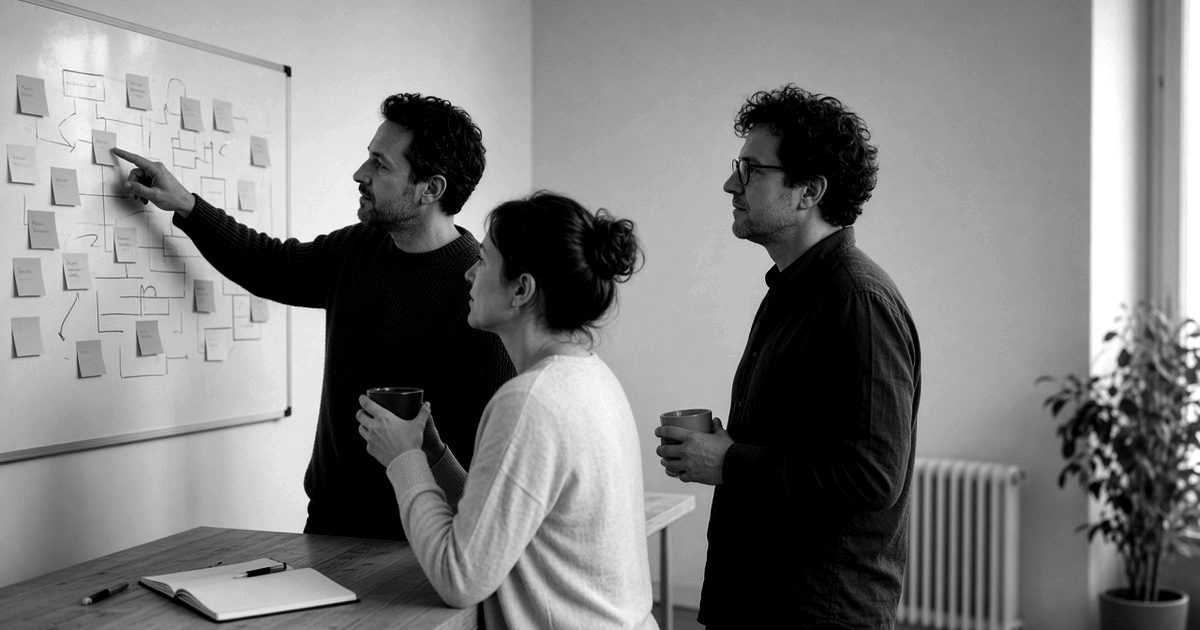
The first step costs nothing and needs no technical knowledge. Ask everyone on the team to spend one week writing down every task they find repetitive, tedious or slow. At this stage it does not matter whether a task looks easy or hard to solve. The goal is to make invisible work visible.
For each task, record just four things:
- What is done, in one sentence.
- How often it is done.
- How long it takes each time.
- Where the data comes from and where it goes.
This simple list tells you more about the opportunities in your business than any sales pitch. It shows where the time really goes and where the data lives. It also gives you a baseline to measure results against later.
If you cannot describe the task in one sentence, it is not ready to be automated. Simplify the process first.
How to choose the first task
Once the list is done, it is tempting to go after the biggest task. Resist that. The first automation should be small, safe and visible. It should deliver a result everyone notices and build trust in the approach. Three questions help you choose.
Frequency times time
Multiply how often a task is done by how long it takes. A ten-minute task done twenty times a day outweighs a monthly report that takes two hours.
Picture a five-person service team where each person spends twenty minutes a day sorting enquiries and copying details between systems. It does not sound like much. Over roughly 220 working days a year, it still adds up to about 370 hours, or more than nine full working weeks. None of it needs expertise. It just needs time.
What happens if it goes wrong?
Ask what happens if the automated version makes a mistake. An internal summary that a colleague reads before use is low risk. An automatic email to customers or a change in the accounts is not. Start where human review is easy and mistakes are cheap.
Where is the data?
AI works best when the input is predictable. If the data is scattered across emails, sticky notes and one colleague’s head, the first job is to get it into one place. That alone often saves more time than expected.
Only then comes the tool
Once you know which task to solve, how often it comes up and what data it uses, choosing a tool becomes simple. Sometimes a feature in software you already use is enough. Sometimes you need a simple integration between two systems. And sometimes the right answer is to stop doing the task, because nobody uses the result.
That last one is often forgotten. Some zombie tasks should not be automated but retired. The list gives you a chance to ask that question out loud.
Measure before you change anything
Record how long the task takes today before you change anything. Without that number you cannot show results, and without visible results it is hard to win support for the next step. Measure again four weeks after the change. The difference is your case for the next task on the list.
Measure what does not show up in hours as well: fewer errors, shorter waits for customers and people who get to focus on work that needs real judgement. That is often where the biggest gain lies.
Start this week
You do not need a strategy project or a new system to get going. You need one shared list, one week and honest answers from your team. At the end of the week, sit down, rank the tasks by frequency, time and risk, and pick one.
This is exactly the work we do with teams in our one-day Accelerate workshop, where the team maps its own zombie tasks and leaves with a plan for which one gets solved first. The list becomes a roadmap, and the roadmap becomes hours handed back to the team.